Coffee Berry Borer (CBB)/ Coffee Leaf Rust (CLR)
Coffee Berry Borer (CBB)
Species: Hypothenemus hampei
The public is encouraged to report any sightings of this beetle.
Description
- CBB is a bark beetle native to Central Africa that is now distributed throughout coffee-producing countries around the world.
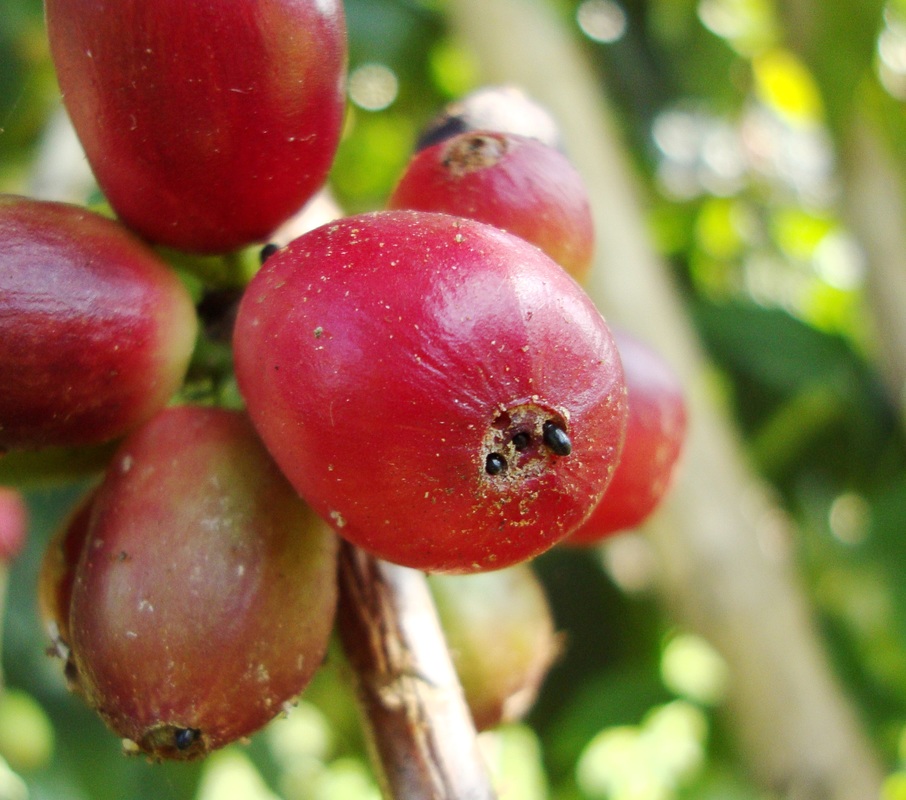
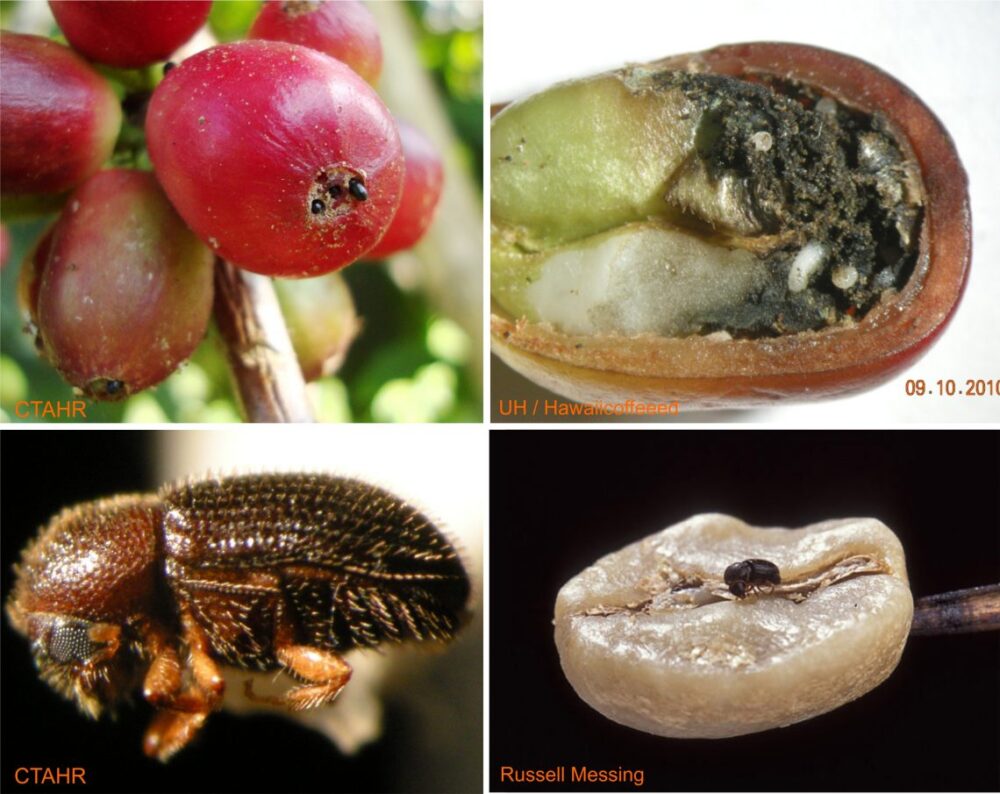
- The beetle is tiny (~2 mm long) and dark colored. Infested coffee berries have a telltale hole (sometimes two holes) visible at the blossom end of the berry. Sometimes a portion of the CBB body is visible entering into the berry.
Impacts
- CBB is one of the most devastating pests of the coffee plant and is a serious economic threat to coffee growers.
- The adult female beetle bores into the coffee cherry and lays her eggs. The larvae hatch inside the cherry, grow and feed on the beans, causing damage to the quality and yield of the coffee harvest.
- Reproduction rate of this pest is very fast and they are easily transported on coffee plants, unroasted coffee beans, and harvesting equipment including coffee bags.
On Kauai
- CBB was confirmed on Kauai for the first time in September 2020. Several additional detections have subsequently been confirmed in the Kalaheo and Lawai area.
- It is very difficult to eradicate CBB once they have been detected. Integrated Pest Management (IPM) practices have been developed and have proven effective in helping mange population numbers and reduce damage. More information
- The public is encouraged to report any sightings of this beetle.
- To send in a suspect sample, place infected coffee beans and/or CBB into a Ziplock bag. On a separate Ziplock bag, write name and address where it was found. Place the first bag into the labeled bag, seal, insert into an envelope, and mail or drop off to: Roshan Manandhar, UH/CTAHR, 3060 Eiwa St, Room 210, Lihue, HI 96766
- If you would like more information regarding CBB management, please contact Roshan Manandhar of CTAHR at (808) 274-3477 or roshanm@hawaii.edu.
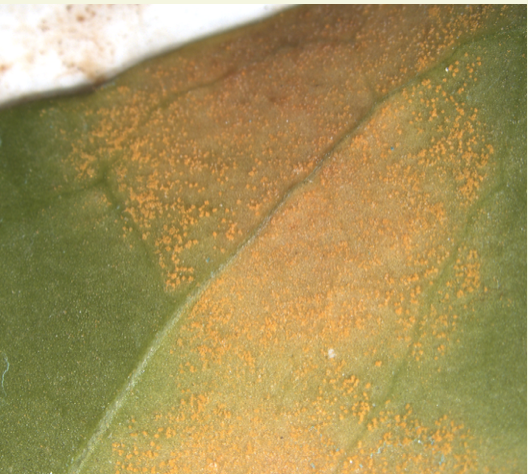
Coffee Leaf Rust (CLR)
Species: Hemileia vastatrix
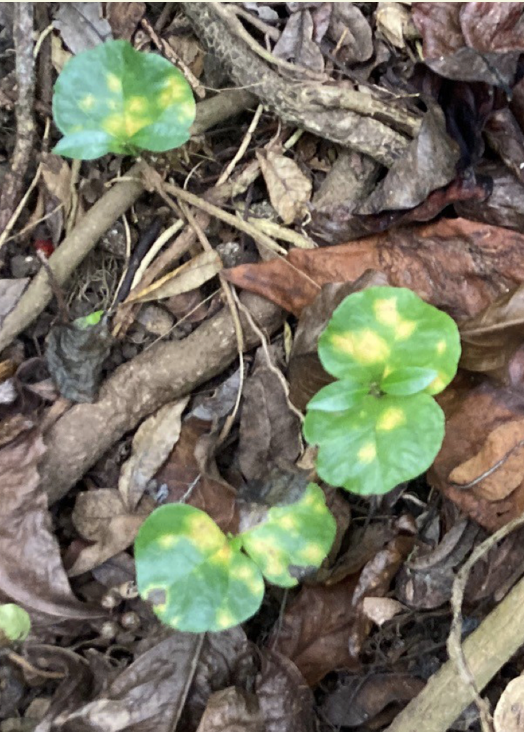
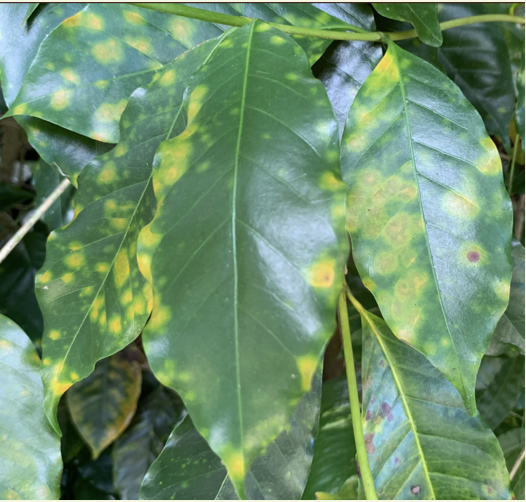
Coffee Leaf Rust, also known as CLR, is a fungal pathogen caused by Hemileia vastatrix. If CLR is left untreated, it can eventually lead to the death of the entire plant. Symptoms of this disease appear first on the upper leaf surface and later on the lower surface of leaves. Severe infections of CLR may lead to premature leaf drop, yield reduction, twig dieback, and even tree death. Other symptoms of CLR are that seedlings may also display yellowish spots and lesions upon sprouting.
If you suspect CLR may have infected coffee near you please call HDOA at 643-PEST or file a report online at 643pest.org.
How you can help protect coffee on Kauaʻi
KISC is asking the community to contact us if they have coffee on their property. We can provide informational materials that will help identify possible infestations as well as offer our services to help survey their coffee plants. This pest has already jumped throughout the islands. Now is the time to take preventative measures and build a network of coffee growers so that we can protect coffee on Kauaʻi.
Coffee is a commonly used landscaping plant, these populations that aren’t being cultivated for consumption are potential breeding grounds for CBB. If these landscaping plants are left unchecked it may threaten neighboring coffee in the community. If you or someone you know grows coffee you may also contact KISC to join the list of coffee growers, hobbyists, and farmers.
Please contact KISC at (808) 821-1490 or kisc@hawaii.edu.