Summary
Welcome to the Invasive Informant, sponsored by Kaua’i Invasive Species Committee. KISC works across Kaua’i to prevent, control, or eliminate the most threatening invasive plant and animal species in order to preserve Kauaʻi’s native biodiversity and minimize adverse ecological, agricultural, economical, and cultural impacts. This month, we discuss how native ʻōhiʻa forests us in our lives.
@Graham Talaber
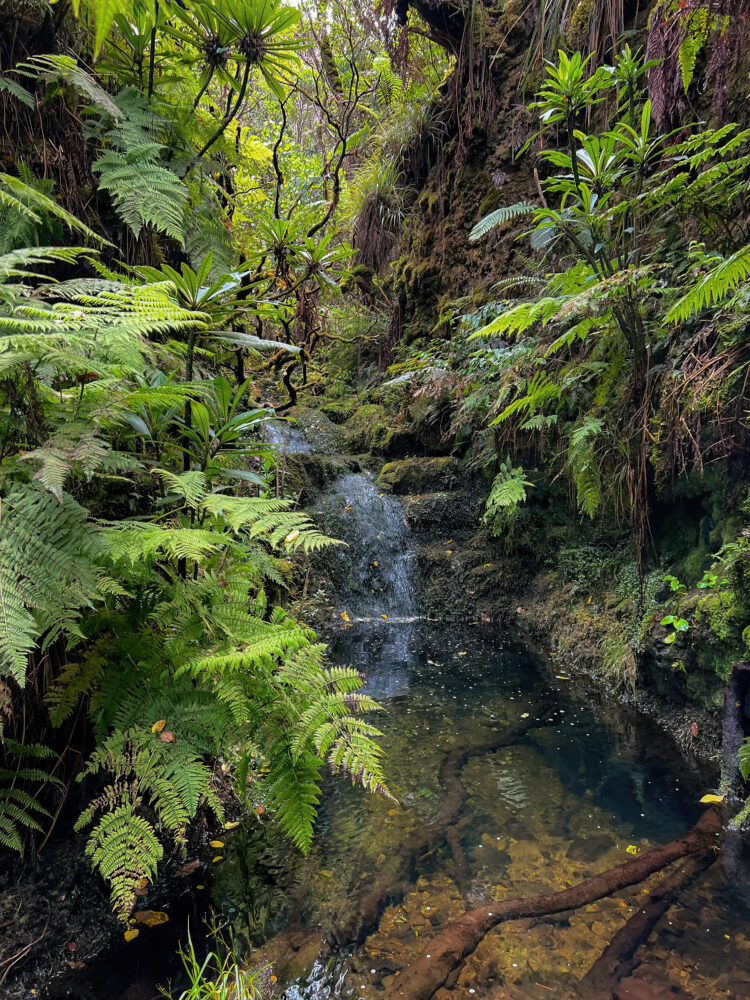
This time of year as night rains soak our yards across the island, I think about the many roles of forest ecosystems on the island. We often talk about forests as watersheds. Watersheds function like a giant sponge, capturing moisture in the mountains as if in slow motion. In a healthy forest with a diversity of native plants, rain trickles down branches and leaves, gets absorbed by mosses, mixes with the roots of myriad trees, plants, and ferns, replenishing underground aquifers for fresh water, eventually making its way down streams and rivers to the sea. Forest ecosystems help filter water and prevent erosion, ensuring we have healthy ocean reefs in which to swim, surf, fish, and play. Watersheds mirror traditional Hawaiian land divisions, known as ahupuʻa, extending from mountain peaks to ocean reefs.
ʻŌhiʻa are the keystone tree species upon which our forest ecosystem relies.
But a fungal disease known as “Rapid ʻŌhiʻa Death” is killing Hawaiiʻs most abundant native tree. ʻŌhi‘a are infected through open wounds, possibly due to peeling bark, torn roots, or broken branches.
Microscopic fungal pathogens enter the wound and the fungus grows inside the tree, preventing the flow of water. The first external symptom is the sudden browning of the leaf canopy. There is no known cure, and after a few months, the tree dies.
Because the fungus moves around the island in mud, brushing mud off footwear and gear before and after entering the forest, then, spraying with isopropyl rubbing alcohol, can help stop the spread of Rapid ʻŌhiʻa Death.